Welcome to the Boston Astronomy website!
This website has been created by and is supported by John Sheff, a Boston, MA - area amateur astronomer and informal astronomy educator. You can contact me at jsheff@bostonastronomy.net. My intention in creating this site is to provide a convenient resource for access to news and information about astronomy and space-related activities of interest to the community and the public.
Upcoming Astronomy-Related Events in the Boston Area
Thursday, April 11, 2024, 8:00 PM - 10 PM
Amateur Telescope Makers of Boston (ATMoB) Monthly Meeting
Harvard-Smithsonian Center for Astrophysics
60 Garden St.
Cambridge, MA 02138
Speaker and Topic: TBA
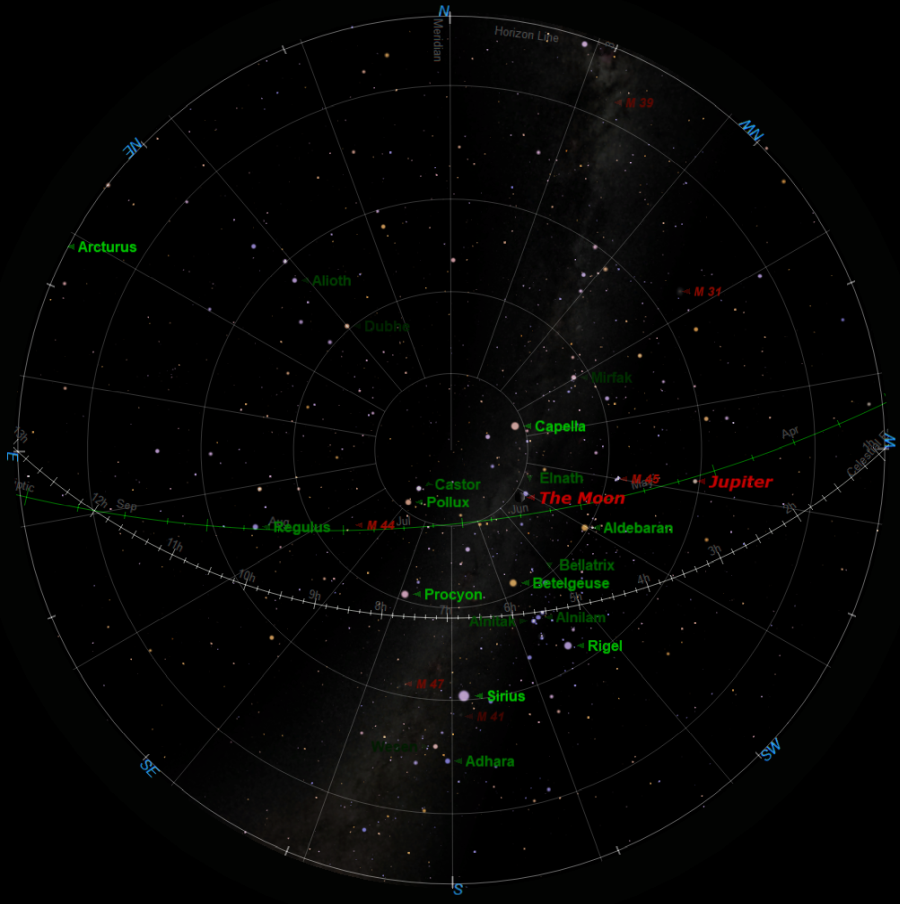
The sky as seen from Boston on March 16, 2024, at 8:00 PM EDT
Major Astronomical Events |
|||
|
April 2024 |
|||
| Apr. 1 | Mon | 11:15 PM EDT | Last Quarter Moon |
| Apr. 5 | Fri. | 12:00 AM EDT | Moon 2° S of Mars, 35° from Sun in morning sky |
| Apr. 6 | Sat. | 5:00 AM EDT | Moon, Mars, and Saturn within circle 3.04° in diameter |
| Apr. 6 | Sat. | 5:00 AM EDT | Moon 1.2° S of Saturn, 33° from Sun in moring sky |
| Apr. 7 | Sun. | 4:00 AM EDT | Moon 0.4° S of Neptune, 20° from Sun in morning sky |
| Apr. 7 | Sun. | 12:44 PM EDT - 1:57 PM EDT | Moon occults Venus (daylight), 15° from Sun in morning sky |
| Apr. 7 | Sun. | 1:51 PM EDT | Moon @ perigee (358,850 km / 222,979 mi / 56.33 Earth radii) |
| Apr. 8 | Mon. | 2:16 PM EDT | Partial solar eclipse begins |
| Apr. 8 | Mon. | 2:20PM EDT | New Moon |
| Apr. 8 | Mon. | 3:29 PM EDT | Maximum partial solar eclipse |
| Apr. 8 | Mon. | 4:39 PM EDT | Partial solar eclipse ends |
| Apr. 9 | Tue. | Juno perijove # 60 | |
| Apr. 10 | Wed. | 4:00 PM EDT | Moon, Jupiter, and Uranus within circle 3.84° in diameter |
| Apr. 10 | Wed. | 5:00 PM EDT | Moon 4° N of Jupiter, 28° from Sun in evening sky |
| Apr. 10 | Wed. | 8:00 PM EDT | Moon 4° N of Uranus, 30° from Sun in evening sky |
| Apr. 10 | Wed. | 11:00 PM EDT | Mars 0.5° N of Saturn, 37° from Sun in morning sky |
| Apr. 14 | Sun. | Boeing Starliner launches to ISS | |
| Apr. 15 | Mon. | 3:13 PM EDT | First Quarter Moon |
| Apr. 18 | Thur. | 1:00 PM EDT | Sun enters Aries |
| Apr. 18 | Thur. | 7:00 PM EDT | Mercury 2° N of Venus, 12° from Sun in morning sky |
| Apr. 19 | Fri. | 10:10 PM EDT | Moon @ apogee (405,624 km / 252,043 mi / 63.67 Earth radii) |
| Apr. 20 | Sat. | 4:00 AM EDT | Jupiter 0.5° S of Uranus, 20° from Sun in evening sky |
| Apr. 22 | Mon. | 2:55 AM EDT | Lyrid meteors peak (poor) |
| Apr. 23 | Tue. | 7:49 PM EDT | Full Moon (Full Pink Moon") |
| Apr. 28 | Sun. | 12:00 AM EDT | Mars 0.04° S of Neptune, 40° from Sun in morning sky |
Bold = cool or important |
* = not visible from Boston | ||
An Overview of Major Astronomical Events in 2024 |
|||
| Jan. 2 | Tue. | 7:38 PM EST | Earth @ perihelion (0.9833 AU / 147,093,163 km / 91,399,454 mi) |
| Jan. 3 | Tue. | 7:13:46 AM EST | Latest sunrise of the year (7:13:46 AM EST) |
| Jan. 4 | Thur. | 5:00 AM EST | Quadrantid meteors peak (fair) |
| Jan. 8 | Mon. | 2:18 AM EST | Astrobotic Peregrine launched to Moon on ULA Vulcan |
| Jan. 8 | Mon. | Autumn begins in Northern Hemisphere of Mars | |
| Jan. 8 | Mon. | 9:46 AM EST - AM 10:55 EST | Moon occults Antares (daylight) |
| Jan. 12 | Fri. | 2:18 PM EST | Mercury @ greatest western elongation (25° W of Sun) |
| Jan. 19 | Fri. | 5:20 AM EDT | Japanese SLIM mission lands near Shioli crater |
| Feb. 3 | Sat. | Juno perijove # 58; Io flyby (1,500 km / 930 mi) | |
| Feb. 15 | Thur. | Intuitive Machiine's NOVA--C launched to Maalpert A | |
| Feb. 28 | Wed. | 4:16 PM EST | Saturn @ solar conjunction |
| Mar. 7 | Thur. | Juno perijove # 59 | |
|
Mar. 10 |
Sun. |
2:00 AM EST / 3:00 AM EDT |
Daylight Saving Time begins |
|
Mar. 17 |
Thur. |
6:53 AM EDT - 6:53 PM EDT |
Equilux (day and night of equal length) |
| Mar. 17 | Sun. | 7:13 AM EDT | Neptune @ solar conjunction |
| Mar. 19 | Tue. | 8:21 PM EDT - 10:16 PM EDT | China launches Queqiao 2 lunar farside relay satellite |
|
Mar. 19 |
Tue. |
11:01 PM EDT |
March (Spring) Equinox |
| Mar. 24 | Sun. | 1:55 PM EDT | Mercury @ greatest eastern elongation (19.5° E of Sun) |
| Mar. 25 | Mon. | 12:53 AM EDT - 5:32 AM EDT | Penumbral lunar eclipse (max. @ 3:13 AM EDT) |
| Mar. 30 | Sat. | Parker Solar Probe perihelion # 19 | |
| Apr. 7 | Sun. | 12:44 PM EDT - 1:57 PM EDT | Moon occults Venus (daylight) |
| Apr. 8 | Mon. | Total solar eclipse | |
| Apr. 9 | Sat. | Juno perijove # 60 | |
| Apr. 14 | Sun. | Boeing Starliner launches to ISS | |
| Apr. 22 | Mon. | 2:55 AM EDT | Lyrid meteors peak (poor) |
| May 9 | Thur. | 3:44 AM EDT | Mercury @ greatest western elongation (26° W of Sun) |
| May 12 | Sun. | Juno perijove # 61 | |
| May 13 | Mon. | 5:04 AM EDT | Uranus @ solar conjunction |
| May 18 | Sat. | 2:343 PM EDT | Jupiter @ solar conjunction |
| Jun. 4 | Tue. | 12:03 PM EDT | Venus @ superior conjunction |
| Jun. 7 | Fri. | Winter solstice in Northern Hemisphere of Mars | |
| Jun. 14 | Fri. | 5:07 AM EDT | Earliest sunrise of year (5:07:00 AM EDT) |
| Jun. 20 | Thur. | 4:49 PM EDT | June (Summer) Solstice |
| Jun. 22 | Sat. | Juno perijove # 62 | |
| Jun. 27 | Thur. | 8:25 PM EDT | Latest sunset of year (8:25:23 PM) |
| Jun. 30 | Sun. | Parker Solar Probe perihelion # 20 | |
|
Jul. 5 |
Fri. | 1:06 AM EDT | Earth @ aphelion (1.017 AU / 152.1 milion km / 94,510,886 miles) |
| Jul. 13 | Sat./Sun. | 11:22 PM EDT - 12:11 PM EDT | Moon occults Spica |
| Jul. 17 | Wed. | 4:06 AM EDT | Juno perijove # 63 |
| Jul. 21 | Sun. | 11:37 PM EDT | Mercury @ greatest eastern elongation (26° E of Sun) |
| Aug. 6 | ESCAPADE Smallsats launched on New Glenn to orbit Mars | ||
| Aug. 12 | Mon. | 10:00 AM EDT | Perseid meteors peak (fair) |
| Aug. 18 | Sun. | Juno perijove # 6 | |
| Aug. 23 | Fri. | JUICE Mission Moon (750 km / 466 mi)-Earth (6,800 km / 4,225 mi) flyby | |
| Sept. 4 | Wed. | 10:24 PM EDT | Mercury @ greatest western elongation (18° W of Sun) |
| Sept. 5 | Thur. | Bepi-Comobo Mercury flyby # 4 | |
| Sept. 6 | Fri. | 11:31 AM EDT - 12:44 PM EDT | Moon occults Spica (daytime) |
| Sept. 8 | Sun. | 12:27 AM EDT | Saturn @ opposition |
| Sept. 17 | Tue. | 8:41 PM EDT - 12:47 AM EDT | Partial lunar eclipse |
| Sept. 18 | Wed. | 4:10 AM EDT - 4:35 AM EDT | Moon occults Neptune |
| Sept. 20 | Fri. | Juno perijove # 65 | |
| Sept. 20 | Fri. | 8:08 PM EDT | Neptune @ opposition |
| Sept. 22 | Sun. | 8:43 AM EDT | September (Fall) Equinox |
| Sept. 27 | Fri. | Comet C/2023 A3 (Tsuchinshan-ATLAS) @ perihelion | |
| Sept. 30 | Mon. | Parker Solar Probe perihelion # 21 | |
| Oct. 2 | Wed. | 11:44 PM EDT - 5:46 PM EDT | Annular solar eclipse (E. Pacific, Patagonia, S. Atlantic) |
| Oct. 8 | Tue. | 9:08 AM EDT | Draconid meteors peak (fair) |
| Oct. 10 | Thur. | Europa Clipper launch to Jupiter | |
| Oct. 12 | Sat. | Comet C/2023 A3 (Tsuchinshan-ATLAS) @ closest approach | |
| Oct. 23 | Wed. | Juno perijove # 66 | |
| Oct. 21 | Sat. | 8:00 PM EDT | Orionid meteors peak (excellent) |
|
Oct. 28 |
Sat. |
5:40 PM EDT |
Partial lunar eclipse |
|
Nov. 3 |
Sun. |
1:00 AM EST / 2:00 AM EDT |
Daylight Saving Time ends |
| Nov. 6 | Wed. | Parker Solar Probe Venus flyby # 7 | |
| Nov. 11 | Mon. | 9:19 PM EDT - 10:28 PM EDT | Moon occults Neptune |
| Nov. 12 | Tue. | Spring begins in Northern Hemisphere of Mars | |
| Nov. 16 | Sat. | 4:18 AM EST | Mercury @ greatest eastern elongation (22° E of Sun) |
| Nov. 16 | Sat. | 9:37 PM EST | Uranus @ opposition |
|
Nov. 17 |
Sun. |
7:00 PM EST |
Leonid meteors peak. (poor) |
| Nov. 25 | Mon. | Juno perijove # 67 | |
| Nov. 27 | Wed. | 5:39 AM EST - 6:55 AM EST | Moon occults Spica |
| Dec. 2 | Mon. | BepiColombo Mercury flyby # 5 | |
| Dec. 7 | Sat. | 3:51 PM EST | Jupiter @ opposition |
|
Dec. 8 |
Sun. |
4:11 PM EST |
Earliest sunset of year (4:11:40 PM EST) |
| Dec. 13 | Fri. | Lucy Earth flyby # 2 | |
|
Dec. 14 |
Thur. |
2:00 PM EST |
Geminid meteors peak. (poor) |
|
Dec. 21 |
Sat. |
4:20 AM EST |
December (Winter) Solstice |
|
Dec. 22 |
Thur. | 5:00 AM EST | Ursid meteors peak (fair) |
| Dec. 24 | Tue. | Parker Solar Probe perihelion # 22 (6.1 million km / 3.8 million mi / .04 AU | |
| Dec. 25 | Wed. | 2:10 AM EST | Mercury @ greatest western elongation (22° W of Sun) |
| Dec. 28 | Sat. | Juno perijove # 68 | |
| Dec. 30 | Mon. | Rocket Labs Venus Life Finder launch | |
| Dates to be announced: |
|||
| Apr. | Sierra Space's Dream Chaser launched to ISS | ||
| May | Chang'e 6 launched for farside sample return | ||
| Oct. | ESA Hera mission launched to asteroid Didymos/Dimorphos | ||
| Nov. | NASA VIPER lunar rover launches to Moon's South Pole | ||
| 3Q - 4Q | Firefly's Blue Ghost lunar lander launched to Mare Crisium | ||
Bold = cool or important |
* = not visible from Boston | ||